AI Hydra vs. The Snake Game
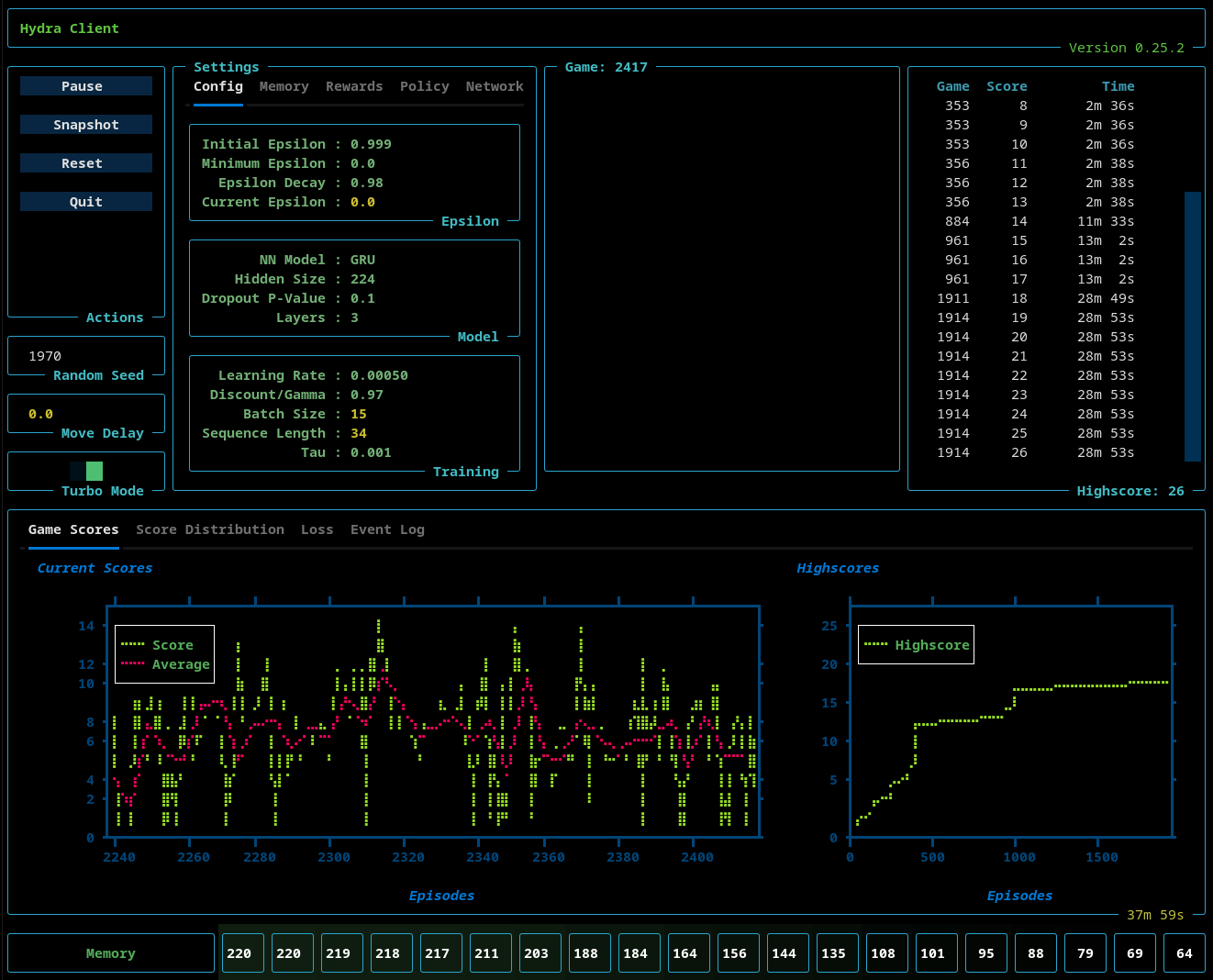
AI Hydra is a distributed reinforcement learning platform composed of three core components:
- HydraClient — a Textual TUI for control and visualization
- HydraRouter — a lightweight message router
- HydraMgr — a headless simulation and training engine
All components communicate over ZeroMQ, forming a clean separation between control, execution, and visualization.
The client sends control messages (e.g., handshake, start) to the router, which forwards them to the server. The server runs the simulation and publishes telemetry via PUB/SUB sockets. The client subscribes to these streams and renders the system state in real time.
Telemetry is split into two channels:
- Per-step updates — board state (snake position, food, score)
- Per-episode updates — metrics (high score, loss, epsilon, etc.)
This separation allows fine-grained control over performance and observability.
Project Documents
- Getting Started
- Distributed Architecture
- Settings
- Models and Reproducibility
- Visualizations
- ATH Replay Memory
- Train Manager
- Epsilon Nice — Bounded Safe-Detour Policy
- Performance
- Snapshot Report
Closing Thoughts
AI Hydra is not just a simulation engine — it is a learning ecosystem.
Its components — adaptive replay memory, dynamic policy layers, and real-time orchestration — do not operate in isolation. They interact.
- The gearbox reshapes temporal learning
- The policy adapts under changing constraints
- Recovery mechanisms respond to stagnation signals
Together, they form a system where behavior is not explicitly programmed, but emerges from the interaction of these parts.
The result is a tightly coupled environment where:
- learning dynamics are visible
- iteration is fast
- and meaningful behavior can emerge from system-level feedback
AI Hydra is not just running games.
It is evolving behavior.